


Written by Gerard Castro, CTO at Nebbo.
Introduction
Seasonal forecasting represents one of the most challenging frontiers in meteorology, attempting to predict weather patterns weeks to months in advance. Unlike short-term weather forecasts that rely on the initial atmospheric state, seasonal forecasts depend on identifying and leveraging slower-evolving components of the Earth system that provide predictability beyond the typical 10-14 day limit of deterministic weather prediction (Shukla & Kinter, 2006). These components act as “sources of predictability” – physical processes or states that evolve slowly enough to influence atmospheric conditions over extended periods.
This post explores the primary sources of predictability that enable seasonal forecasting, examining how each contributes to our ability to anticipate weather patterns months ahead. Understanding these sources is crucial for both meteorologists developing forecast systems and users interpreting seasonal outlooks, as they define the fundamental limits and opportunities of long-range prediction.
Sea Surface Temperature: The Primary Driver
Sea surface temperature (SST) stands as the most significant source of predictability in seasonal forecasting, serving as the foundation upon which most seasonal prediction systems are built (Latif et al., 1998). The ocean’s enormous heat capacity means that SST anomalies persist for months, providing a stable forcing on the atmosphere that can generate predictable weather patterns.
Why SSTs Matter
Several characteristics make SSTs particularly valuable for seasonal prediction:
- Thermal Inertia: The ocean’s high heat capacity means it warms and cools much more slowly than the atmosphere, allowing SST patterns to persist for months (Luo et al., 2011).
- Global Coverage: Oceans cover approximately 71% of Earth’s surface, providing extensive influence on atmospheric circulation.
Teleconnection Generator: Many major teleconnection patterns (like ENSO) are driven by SST anomalies (Chang et al., 2006).
ENSO: The Cornerstone of Seasonal Prediction
The El Niño-Southern Oscillation (ENSO) represents the most powerful source of seasonal predictability globally. This coupled ocean-atmosphere phenomenon in the tropical Pacific drives global teleconnections that affect weather patterns worldwide (Latif et al., 1998; Kumar & Hu, 2014).
ENSO’s predictive value stems from:
- Long Development Time: ENSO events typically develop over several months and persist for 9-12 months.
- Consistent Teleconnections: ENSO phases are associated with relatively consistent weather patterns in many regions (Chang et al., 2006).
- Advance Warning: Subsurface ocean temperature anomalies often provide early indications of developing ENSO events (Luo et al., 2011).
Other Ocean Basins
While the tropical Pacific dominates seasonal predictability through ENSO, other ocean basins also contribute:
- Tropical Atlantic: Sea surface temperature patterns in the tropical Atlantic influence hurricane activity, rainfall in the Americas and Africa, and can modulate ENSO impacts (Shin & Newman, 2021).
- Indian Ocean Dipole (IOD): This oscillation in SSTs across the Indian Ocean affects precipitation patterns in East Africa, Australia, and parts of Asia (Newman & Sardeshmukh, 2017).
- North Atlantic: SST patterns in the North Atlantic influence the North Atlantic Oscillation (NAO) and European weather, particularly in winter.
- North Pacific: The Pacific Decadal Oscillation (PDO) and North Pacific Mode (NPM) provide additional sources of predictability, especially for North America (Shin & Newman, 2021).
Additional Considerations in Seasonal Predictability
Beyond the primary sources of predictability discussed above, several additional factors contribute to our ability to forecast seasonal conditions. While these elements are covered in greater detail in other posts, they warrant mention as important components of the seasonal forecasting system.
Cryosphere: Ice and Snow
The cryosphere – Earth’s frozen water in the form of sea ice, snow cover, and ice sheets – provides significant seasonal predictability, particularly for mid and high-latitude regions.
Sea Ice
Sea ice influences seasonal weather patterns through several mechanisms:
- Thermal Insulation: Sea ice insulates the relatively warm ocean from the cold atmosphere, affecting heat exchange and atmospheric circulation (Holland et al., 2011).
- Albedo Effects: The high reflectivity of sea ice compared to open water creates feedback loops that influence regional temperature patterns.
- Persistence: Sea ice anomalies can persist for months, particularly when they survive through the summer melt season (Holland et al., 2011).
Arctic sea ice conditions particularly affect winter weather patterns across the Northern Hemisphere, with low sea ice extent often associated with colder winters in parts of Eurasia and eastern North America through complex atmospheric pathways.
Snow Cover
Snow cover represents another important cryospheric source of predictability:
- Thermal Properties: Snow’s insulating properties and high albedo affect surface temperature and energy balance.
- Soil Moisture Influence: Spring snowmelt affects soil moisture into the summer, influencing temperature and precipitation patterns.
- Atmospheric Feedback: Extensive snow cover can reinforce cold air masses and influence atmospheric circulation patterns (Cohen & Entekhabi, 1999).
Eurasian snow cover in October has been linked to winter conditions in Europe and North America through its influence on the Arctic Oscillation, providing a valuable predictor for winter seasonal outlooks (Cohen & Entekhabi, 1999).
Snow Mass
Beyond simple snow cover extent, snow mass (the water equivalent contained in snowpack) provides additional predictability:
- Melt Energy Requirements: Greater snow mass requires more energy to melt, prolonging snow cover and its associated effects.
- Hydrological Impacts: Snow mass determines spring runoff volumes, affecting soil moisture, river flows, and reservoir levels.
- Thermal Inertia: Deep snowpack can maintain colder surface conditions even during warm spells.
Mountain snowpack is particularly important for regional hydrological prediction, with implications for water resources management and flood risk.
Land Surface Conditions
The land surface serves as a critical source of predictability through its influence on energy and water exchanges with the atmosphere.
Soil Moisture
Soil moisture conditions provide predictability through several mechanisms:
- Thermal Properties: Wet soils have higher heat capacity and conductivity than dry soils, affecting temperature extremes (Seneviratne et al., 2010).
- Evapotranspiration: Soil moisture availability controls evapotranspiration rates, influencing humidity, cloud formation, and precipitation.
- Persistence: Soil moisture anomalies can persist for weeks to months, particularly in deeper soil layers (Koster et al., 2000).
Soil moisture is particularly important for predicting summer temperature extremes and drought conditions, with dry soils often amplifying and prolonging heat waves through reduced evaporative cooling (Seneviratne et al., 2010).
Vegetation
Vegetation dynamics provide an additional source of predictability:
- Transpiration Control: Plants regulate water transfer from soil to atmosphere, affecting local humidity and energy balance.
- Albedo Effects: Vegetation changes alter surface reflectivity, influencing radiation balance.
- Seasonal Cycles: Predictable phenological cycles (greening, senescence) influence surface properties.
In regions with strong vegetation-climate coupling, such as monsoon regions and semi-arid areas, vegetation state can significantly influence seasonal weather patterns.
Groundwater
Deeper water storage in aquifers provides a longer-term memory component:
- Baseflow Contribution: Groundwater sustains river flows during dry periods, affecting regional humidity.
- Deep Soil Moisture: Groundwater influences deep soil moisture available to deep-rooted vegetation.
- Multi-year Memory: Groundwater anomalies can persist for years, bridging between seasons.
While challenging to observe and model globally, groundwater represents an important source of multi-seasonal to interannual predictability in regions with strong land-atmosphere coupling.
Stratospheric Processes
The stratosphere – the atmospheric layer approximately 10-50 km above Earth’s surface – provides additional sources of predictability for seasonal forecasts.
Stratospheric Polar Vortex
The stratospheric polar vortex – a large-scale cyclonic circulation that forms over the poles during winter – significantly influences tropospheric weather patterns:
- Downward Propagation: Disruptions to the stratospheric polar vortex (sudden stratospheric warmings) often propagate downward, affecting tropospheric circulation patterns weeks later (Baldwin & Dunkerton, 2001).
- AO/NAO Modulation: Stratospheric conditions strongly influence the Arctic and North Atlantic Oscillations (Scaife et al., 2016).
- Persistence: Stratospheric anomalies typically persist longer than tropospheric anomalies, providing extended predictability.
The state of the stratospheric polar vortex in early winter provides valuable information for late winter forecasts in the Northern Hemisphere (Baldwin & Dunkerton, 2001).
Quasi-Biennial Oscillation (QBO)
The QBO – an alternating pattern of easterly and westerly winds in the tropical stratosphere with a period of approximately 28 months – offers another source of predictability:
- Tropical Influence: The QBO modulates tropical convection and the Madden-Julian Oscillation.
- Polar Connection: The QBO state influences the stability of the polar vortex, affecting mid-latitude weather (Scaife et al., 2016).
- High Predictability: The QBO itself is highly predictable months in advance due to its regular oscillation.
The QBO’s influence is most pronounced during winter in the Northern Hemisphere, providing a valuable predictor for seasonal outlooks (Scaife et al., 2016).
Teleconnections and Weather Regimes
Teleconnections – statistical relationships between weather events in distant parts of the globe – represent both mechanisms through which predictability sources influence remote regions and the sources of predictability themselves. Major patterns like the North Atlantic Oscillation (NAO), Arctic Oscillation (AO), and Pacific-North American Pattern (PNA) provide valuable predictability at seasonal timescales. Similarly, persistent weather regimes such as blocking patterns and specific jet stream configurations can bridge the gap between seasonal and shorter-term prediction. For a comprehensive exploration of this topic, see our dedicated post on Teleconnections and their role in seasonal weather forecasting.
External Forcing Factors
External factors occasionally provide additional predictability for seasonal forecasts:
- Solar Variability: The 11-year solar cycle may influence seasonal conditions through variations in ultraviolet radiation affecting stratospheric conditions.
- Volcanic Eruptions: Major eruptions injecting aerosols into the stratosphere can influence global climate for 1-3 years through radiative effects and circulation changes.
Practical Challenges
Several practical challenges affect our ability to leverage these sources of predictability:
- Observation Limitations: Many key components (ocean subsurface, soil moisture, snow mass) remain inadequately observed.
- Model Representation: Accurately modeling complex coupled processes requires ongoing development.
- Non-Stationarity: Climate change alters the behavior of many predictability sources, requiring adaptive forecast systems.
Summary
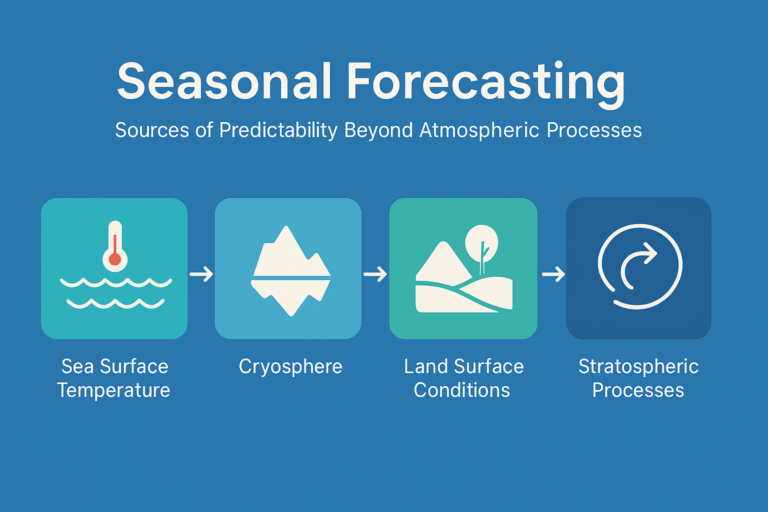
Seasonal forecasting relies on multiple sources of predictability that extend beyond the chaotic limits of atmospheric prediction. Sea surface temperature (particularly ENSO) provides the foundation, complemented by the cryosphere, land surface conditions, and stratospheric processes.
These diverse sources create a complex mosaic of predictability that varies by region and season. Modern forecast systems integrate them through coupled Earth system models (van Oldenborgh et al., 2005; Balmaseda & Anderson, 2009), though challenges in observations, modeling, and climate change adaptation remain.
Understanding these sources helps users interpret seasonal forecasts more effectively, recognizing both their value and limitations in planning for future seasons.
References
Baldwin, M. P., & Dunkerton, T. J. (2001). Stratospheric harbingers of anomalous weather regimes. Science, 294(5542), 581-584. https://doi.org/10.1126/science.1063315
Balmaseda, M., & Anderson, D. L. T. (2009). Impact of initialization strategies and observations on seasonal forecast skill. Geophysical Research Letters, 36, L01701. https://doi.org/10.1029/2008GL035561
Chang, P., Yamagata, T., Schopf, P., Behera, S. K., Carton, J., Kessler, W. S., et al. (2006). Climate fluctuations of tropical coupled systems—the role of ocean dynamics. Journal of Climate, 19, 5122-5174. https://doi.org/10.1175/JCLI3903.1
Cohen, J., & Entekhabi, D. (1999). Eurasian snow cover variability and Northern Hemisphere climate predictability. Geophysical Research Letters, 26(3), 345-348. https://doi.org/10.1029/1998GL900321
Holland, M. M., Bailey, D. A., & Vavrus, S. (2011). Inherent sea ice predictability in the rapidly changing Arctic environment of the Community Climate System Model, version 3. Climate Dynamics, 36(7-8), 1239-1253. https://doi.org/10.1007/s00382-010-0792-4
Koster, R. D., Suarez, M. J., Ducharne, A., Stieglitz, M., & Kumar, P. (2000). A catchment-based approach to modeling land surface processes in a general circulation model: 1. Model structure. Journal of Geophysical Research: Atmospheres, 105(D20), 24809-24822. https://doi.org/10.1029/2000JD900327
Kumar, A., & Hu, Z. Z. (2014). How variable is the uncertainty in ENSO sea surface temperature prediction? Journal of Climate, 27(7), 2779-2788. https://doi.org/10.1175/JCLI-D-13-00576.1
Latif, M., Anderson, D., Barnett, T., Cane, M., Kleeman, R., Leetmaa, A., et al. (1998). A review of the predictability and prediction of ENSO. Journal of Geophysical Research, 103(C7), 14375-14393. https://doi.org/10.1029/97JC03413
Luo, J. J., Behera, S. K., Masumoto, Y., & Yamagata, T. (2011). Impact of global ocean surface warming on seasonal-to-interannual climate prediction. Journal of Climate, 24, 1626-1646. https://doi.org/10.1175/2010JCLI3645.1
Newman, M., & Sardeshmukh, P. D. (2017). Are we near the predictability limit of tropical Indo-Pacific sea surface temperatures? Geophysical Research Letters, 44, 8520-8529. https://doi.org/10.1002/2017GL074088
Scaife, A. A., Karpechko, A. Y., Baldwin, M. P., Brookshaw, A., Butler, A. H., Eade, R., et al. (2016). Seasonal winter forecasts and the stratosphere. Atmospheric Science Letters, 17(1), 51-56. https://doi.org/10.1002/asl.598
Seneviratne, S. I., Corti, T., Davin, E. L., Hirschi, M., Jaeger, E. B., Lehner, I., et al. (2010). Investigating soil moisture–climate interactions in a changing climate: A review. Earth-Science Reviews, 99(3-4), 125-161. https://doi.org/10.1016/j.earscirev.2010.02.004
Shin, S. I., & Newman, M. (2021). Seasonal predictability of global and North American coastal sea surface temperature and height anomalies. Geophysical Research Letters, 48(13), e2021GL093373. https://doi.org/10.1029/2020GL091886
Shukla, J., & Kinter, J. L. (2006). Predictability of seasonal climate variations: A pedagogical review. In T. Palmer & R. Hagedorn (Eds.), Predictability of Weather and Climate. Cambridge, UK: Cambridge University Press. https://doi.org/10.1017/CBO9780511617652.007
van Oldenborgh, G. J., Balmaseda, M. A., Ferranti, L., Stockdale, T. N., & Anderson, D. L. T. (2005). Evaluation of atmospheric fields from the ECMWF seasonal forecasts over a 15-year period. Journal of Climate, 18, 3250-3269. https://doi.org/10.1175/JCLI3421.1
